


In the last article I wrote about the decision gap, the space between collecting data and making a decision with confidence. Most organisations invest heavily in collection, but the intelligence needed to act on it doesn't follow automatically. It has to be built.
The process of building intelligence from raw data is called the intelligence cycle. It's been used in high-stakes decision-making environments for decades, and any organisation can use it. Once you see how it works, you'll recognise both where it applies and where your organisation is probably skipping a step.
What is the Intelligence Cycle?
It's a disciplined process for turning questions into decisions. The logic is straightforward, and it runs in five stages: Direction, Collection, Processing, Analysis, and Dissemination.
- Direction comes first. Before any data is collected, you define the decisions to be made and the questions to be answered to make them. This is the stage many organisations skip entirely.
- Collection is what most organisations do first, gathering information from sensors, feeds, reports, market data, and any other source that might be relevant. It often stops there. The raw material gets written up into a report, but no one has defined what decision that report is meant to support.
- Processing turns raw collected material into something usable. Organising it, validating it, preparing it for analysis.
- Analysis is where collected information becomes intelligence. It's the stage that requires judgment, turning what's been collected into an understanding of what it means for the decision at hand.
- Dissemination gets the right intelligence to the right decision-maker at the right time, in a form they can act on.
The cycle then feeds back into direction. What the decision-maker learns shapes the next round of questions. Most organisations are running one or two of these stages, and dealing with decisions that take too long, get revisited, or don't hold up once acted on.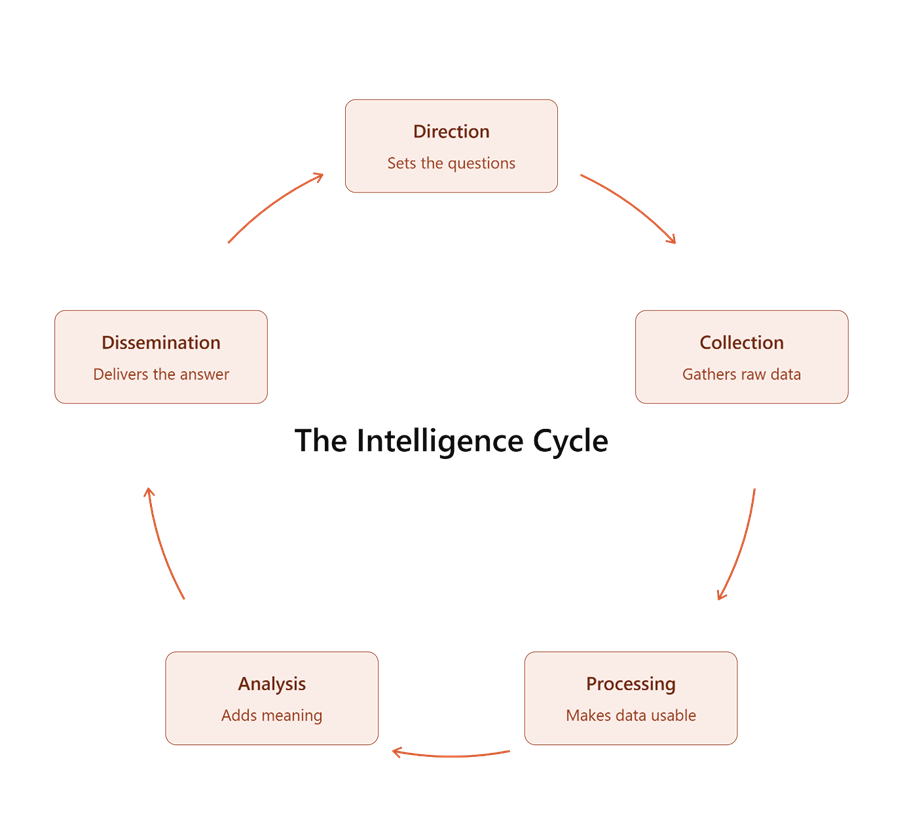 Figure 1: The Intelligence Cycle
Why Does It Look Familiar?
Even if you're not a national security organisation, you've most likely been running parts of the intelligence cycle for years:
- A risk assessment that defines what you need to understand before a project begins is already direction.
- Gathering competitor data through a market research program is collection.
- When a weekly leadership briefing synthesises operational reports, that's analysis and dissemination working together.
These processes are often separate. The risk assessment, the market research, the leadership briefing are each built for their own purpose and run on their own timeline, disconnected from the others. What's usually missing is the discipline to run them as one process.
Most organisations start at collection because collection feels productive, gathering data before they've defined the question it's meant to answer. Analysis gets compressed or skipped because there's no time left and no clear process for it. What reaches decision-makers is usually a data report, or a summary of what happened, rather than a product that sets out the options, the reasoning behind them, and what each one means for the decision-maker.
What Happens Without It?
Consider a critical infrastructure operator running a drone inspection program across a high-voltage transmission network. The program is well funded. The aircraft are capable. The imagery is high resolution and collected on a regular schedule.
Months in, the maintenance team is overwhelmed with thousands of images, flagged anomalies, and condition reports. The people reviewing the imagery are doing their best, but nobody defined up front what decisions the program was meant to support. The inspection schedule was built around what the aircraft could cover, not around what the organisation needed to decide.
The result is a large volume of data that doesn't clearly connect to maintenance priorities, asset risk, or budget decisions. Decision-makers are no better informed than before the program started, and in some ways worse off; they now have data they can't act on with confidence.
Skipping the first stage of the cycle, direction, is one way the decision gap opens. Any stage can fail the same way, resulting in data that doesn't inform the decision it was meant to support.
When the Cycle Works
I've seen the intelligence cycle work well in emergency services incident management, where the stakes are high, and the timing is urgent.
Before an incident, the team defines the decisions the incident controller will need to make and the information required to make them. Collection is structured around those requirements. Information from ground crews, aerial observations, weather services, and public reporting is processed and assessed before it reaches the controller. What lands on their desk is a picture of the situation, built to show what's happening, what it means, and what the options are.
The controller still makes the decisions. The intelligence cycle works through the same five stages to build the picture those decisions are based on and get it to the right person in time to act.
Where to Start
The same five stages apply whether you're deciding where to expand, how to respond to a security threat, or which asset to fund, or any decision that depends on getting the right information to the right person.
Start with whatever decision is causing the most pressure right now, the one where a wrong call costs the most or the clock is running out fastest. Write down what you need to know to make that decision. Then ask whether your collection process is designed to capture the data you need, or whether it's gathering what's easy to gather and hoping the necessary information is in there somewhere.
This first stage of the intelligence cycle is what many organisations miss and where they find the most immediate return.
If this is playing out in your organisation, get in touch; I'd like to hear about it. The next article will look at how Fire Hawk Services applies this through Precision Aerial Intelligence, working with drone and aircraft programs that are collecting data and need help turning it into intelligence that informs sound decisions.