


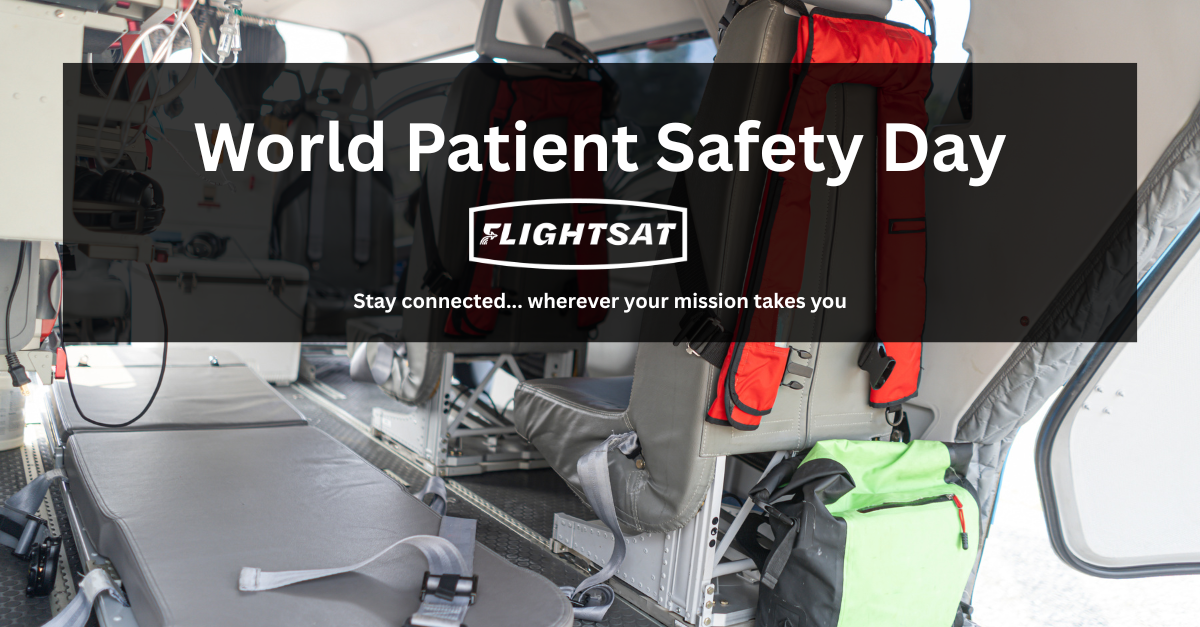
World Patient Safety Day, held annually on 17 September, was established by the World Health Organization (WHO) to raise awareness and encourage action to improve patient safety globally. In 2025, the campaign is dedicated to safe care for every newborn and every child (birth to nine years), with the slogan “Patient safety from the start!” (WHO, 2025).
In aeromedical retrieval, patient safety depends on clinical skill and equipment, as well as the ability to communicate in real time with hospitals and specialists. That communication is often disrupted or unavailable when flying over remote or low-coverage regions. For neonatal and paediatric transports in particular, timely specialist consultation and pre-notification to receiving teams improves coordination of care and patient safety (NETS NSW).
Communication is a Clinical Risk
Without a stable communication link, medical teams in flight may be unable to:
- Seek specialist advice if a patient’s condition changes en route
- Alert the hospital team about critical care needs ahead of arrival
- Share updates on deteriorating patients or revised ETAs
- Coordinate handovers smoothly at the receiving facility
These gaps can lead to delays in treatment, slower handovers, and more stress for both flight crews and hospital teams.
Many retrieval operations use existing terrestrial networks when available. However, mobile coverage gaps across remote Australia are well documented, affecting safety and reliability of communications in regional and remote areas (Infrastructure Australia, 2019; NSW Mobile Black Spot Program).
Case Study 1: CareFlight’s Efforts to Improve Transport Communication
CareFlight, one of Australia’s major aeromedical services, has tested technologies to improve patient monitoring and communication during air and road transfers.
In a 2022 pilot with Infiniwell and Clarity Medical (now Clarman Medical), CareFlight trialled a system that allowed remote teams to monitor patient vitals continuously during transport. The system, built around SentioWeb (Infiniwell’s patient monitoring software platform) and Recobro Vigile (Clarman’s multiparameter vital sign monitor), provided near real-time data access, trend tracking, and map-based location information for command centres and hospitals. This "allows remote clinical oversight and case review by receiving hospitals" (CareFlight & Infiniwell, 2022).
The official release did not specify the communications platform used in transit. Retrieval operations often rely on available terrestrial networks, which have documented coverage gaps in remote areas. These gaps can cause interruptions and data dropouts.
Case Study 2: Central Australia Aeromedical Retrieval Redesign
In Central Australia, a redesigned aeromedical retrieval and consultation model was introduced in 2018 to strengthen communication between remote health services and hospitals. The model included enhanced telehealth consultations between remote health workers or GPs and hospital physicians. Evaluations reported improvements in timeliness, reduced hospital admissions, shorter hospital stays, and clinician-reported improvements in outcomes for acutely unwell patients (Russell et al., 2024; Johnson et al., 2022).
While the studies do not specify the communications platform used, similar retrieval operations commonly rely on available terrestrial networks (for example, cellular) when in range. Independent evidence shows that coverage in remote Australia is uneven, so connections can drop out (Infrastructure Australia, 2019; NSW Telco Authority, 2024).
Taken together, these examples show the importance and patient‑safety benefits of continuous in‑flight monitoring and telehealth consultation. When data and voice links are uninterrupted, teams can escalate care sooner and receiving hospitals can prepare earlier. When connectivity is interrupted or lagging, the positive effects of real‑time monitoring are reduced.
Why SATCOM Makes a Difference
Satellite communication (SATCOM) addresses patchy or unavailable coverage. Systems like FlightSat, which integrates Starlink’s low-Earth orbit satellite network into aircraft, provide stable, high-bandwidth communication for voice, data, and diagnostics in the air.
The benefits for patient safety include:
- Uninterrupted consultation with hospital-based specialists throughout the journey
- Live transmission of vital signs and medical data during the entire flight
- Immediate notification if a patient’s condition worsens mid-flight
- More accurate ETAs and smoother coordination with receiving hospitals
- Better decision-making on diversions or triage before landing
Instead of relying solely on terrestrial coverage, SATCOM helps ensure that even remote or cross-border transfers are visible to clinical teams on the ground.
World Patient Safety Day Is a Call to Action
The CareFlight and Central Australia examples highlight how improved communication in retrieval medicine supports safer care for newborns and children. They also show the limits of current infrastructure. With SATCOM becoming more accessible, there is an opportunity to make uninterrupted communication standard practice in aeromedical retrieval.
Equipping retrieval aircraft with SATCOM reduces dropouts, supports real-time monitoring, and improves patient safety.
If your organisation works in aeromedical retrieval or emergency response, and you’re interested in exploring how SATCOM supports patient safety, contact us:
FlightSat@firehawkservices.com.au
FlightSat brought to you by Fire Hawk Services
Stay connected wherever the mission takes you
Publication Note: AI tools were used to assist with researching, structuring and editing for clarity. All views expressed are those of the author(s).
Sources
World Health Organization. (2025). World Patient Safety DayCareFlight & Infiniwell. (2022). Emergency Patient Transport Monitoring Pilot
- Russell, D., Zhao, Y., Guthridge, S., Carey, T. A., et al. (2024). The efficiency, timeliness, health outcomes and cost-effectiveness of a new aeromedical retrieval model in Central Australia. Aust J Rural Health, 32(1), 17–28. https://doi.org/10.1111/ajr.13057
- Johnson, R., Wakerman, J., Fitts, M., Russell, D. J., Mathew, S., Liddle, Z., Reeve, D., Zhao, Y., Green, D., Honan, B., & Niclasen, P. (2022, August 30–September 1). Central Australia’s new remote aeromedical retrieval and GP consultation systems: Efficient and effective [Conference poster]. ASA + FNA Conference, Brisbane Convention & Exhibition Centre, Brisbane, QLD, Australia. https://aeromedconference.com/wp-content/uploads/2022/08/ASA-poster-Rich-Johnson-MRaCC-data-Richard-Johnson.pdf
- Aeromedical Society of Australasia. (2022). 2022 – Posters (lists Johnson, R. “Central Australia’s new remote aeromedical retrieval and GP consultation systems: Improving patient outcomes and highly cost-effective”).
- NSW Telco Authority. (2024). Mobile Black Spot Program
- Infrastructure Australia. (2019). Mobile telecommunications coverage in regional and remote areas
- Newborn & Paediatric Emergency Transport Service (NETS NSW). (n.d.). About NETS